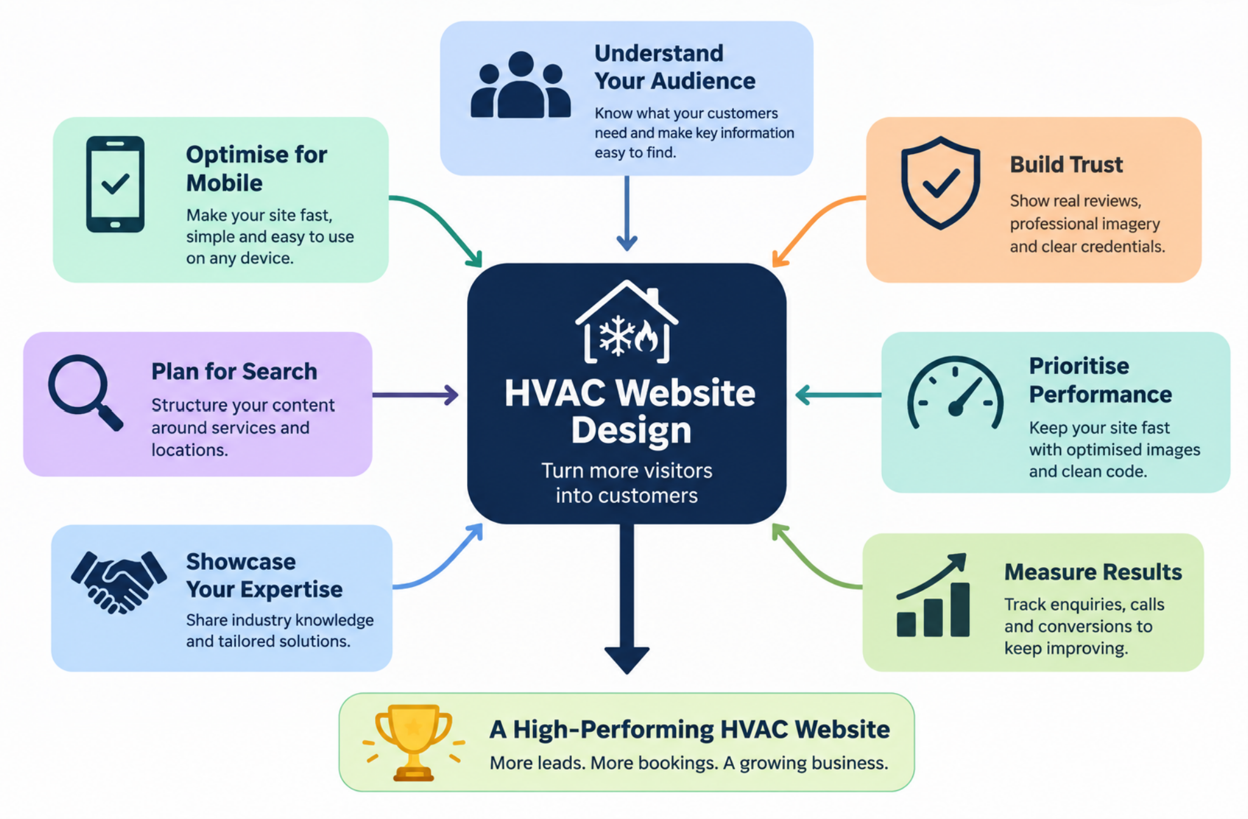
A good website should do more than look attractive. It needs to communicate what a business offers, establish trust and make it easy for potential customers to take the next step.
That sounds straightforward, but the details vary considerably between industries. A portfolio website for a graphic designer has different priorities from a website for a home improvement company. The audience, buying process, questions and reasons for choosing one provider over another are not the same.
The HVAC industry is a particularly good example. Heating and cooling contractors often need to reach customers who are dealing with an uncomfortable home, an urgent repair or an expensive installation decision. Their websites need to communicate quickly, answer practical questions and generate enquiries.
There are several useful lessons here for anyone working in website design, particularly when building websites for businesses in specialist industries.
Design Should Reflect How Customers Actually Behave
Website design should start with the visitor, not the designer's preferred aesthetic.
Someone looking for an HVAC contractor may want to know whether a company repairs air conditioning systems, installs new heating equipment or provides routine maintenance. They may also want to check whether the contractor serves their area and how quickly they can get in touch.
If visitors have to search through several pages to find basic information, the website is creating unnecessary friction.
The same principle applies across other industries. Designers need to understand what visitors are trying to achieve before deciding how information should be presented.
For an HVAC company, this usually means making core services, contact details and service locations easy to find. A visually impressive homepage cannot compensate for a confusing customer journey.
Mobile Design Is Not an Afterthought
Mobile usability is particularly important for service businesses.
A homeowner with a broken air conditioning system is unlikely to spend much time navigating a complicated website on their phone. They want to identify a suitable contractor, check that the company serves their location and make contact.
A well-designed mobile experience should make these actions straightforward.
Important considerations include readable text, clear navigation, accessible phone numbers, sensible page layouts and contact options that work properly on smaller screens.
Designers should also consider how different page elements behave on mobile devices. A layout that looks excellent on a desktop monitor can become frustrating when buttons are difficult to tap or important information is pushed too far down the page.
Responsive design should be considered from the beginning rather than treated as a final adjustment.
Industry Knowledge Makes Better Design Possible
Designing a website for an HVAC contractor requires more than choosing a good template and adding a few service descriptions. The designer needs to understand how heating and cooling customers search, what makes them trust a contractor and what encourages them to make contact.
This is where specialist agencies can bring a different perspective. Honest HVAC Marketing Agency works specifically with residential and light commercial HVAC contractors, with a focus on building websites that support lead generation rather than simply looking professional.
Its approach to HVAC website design reflects the practical requirements of the industry: clear service pages, visible contact options, location relevance, mobile usability and a structure that helps visitors understand what the contractor offers.
That industry knowledge matters. A homeowner looking for emergency AC repair has different priorities from someone researching a new heating installation. A well-designed HVAC website should make both journeys straightforward, giving visitors the information they need and making the next step obvious.
For designers working across specialist industries, the lesson is simple: understanding the customer and the commercial purpose of a website is just as important as its visual presentation.
Trust Is Part of the Visual Experience
People make judgements about businesses based on what they see online. A poorly organised website, inconsistent branding or outdated design can make a company appear less professional.
For HVAC contractors, trust is especially important because customers are often inviting technicians into their homes and committing to work that can involve significant expense.
A website can help establish credibility through consistent branding, clear service descriptions, professional photography, customer reviews and accessible company information.
These elements should work together rather than being added randomly to fill space.
The same applies to other professional services. Good design gives visitors a reason to take a business seriously before they have spoken to anyone.
However, credibility should be genuine. Designers should avoid fabricated testimonials, exaggerated claims and stock imagery that misrepresents the actual business.
Website Performance Is a Design Decision Too
Visual design and technical performance are closely connected.
Large images, unnecessary animations, excessive scripts and poorly optimised layouts can make a website slow and frustrating to use. This affects the visitor experience and can undermine the effectiveness of the entire website.
For businesses that rely on enquiries, performance problems can have a direct commercial cost. A potential customer who abandons a slow page may end up contacting a competitor instead.
Designers should consider image optimisation, responsive assets, efficient page structures and unnecessary third-party scripts during the build process.
Performance should not be left entirely to a developer to address after the visual work is finished. It is part of the design process.
Search Visibility Should Influence Website Architecture
A business website needs to be understandable to both visitors and search engines.
For an HVAC contractor, that means organising content around the services the company actually provides and the locations it serves. Air conditioning repair, heating installation and routine maintenance may each need dedicated pages if they represent distinct services and search intentions.
Service area content can also help explain where the contractor operates, provided those pages contain useful and accurate local information.
The wider search landscape makes clear website structure even more important. Search engines and AI-powered systems need to understand what a business does, which services it offers and where it operates.
Clear headings, descriptive page titles, useful internal links and specific service information all help establish that context.
The objective is not to repeat keywords as often as possible. It is to make the subject of each page clear and provide information that genuinely answers the visitor's questions.
This is relevant beyond HVAC. Any designer building websites for specialist businesses should consider how the site's structure supports discoverability as well as usability.
Design Success Should Be Measured Beyond Appearance
A website can win design awards and still fail to generate business.
For commercial websites, success needs to be measured against what the business wants to achieve. That might include enquiries, phone calls, bookings, quote requests or product sales.
For an HVAC contractor, useful measurements could include:
● How many visitors contact the business?
● Are visitors using the phone number or enquiry form?
● Which service pages generate the most enquiries?
● Are visitors finding the relevant location pages?
● Do mobile visitors complete the same actions as desktop visitors?
● Which traffic sources produce genuine business opportunities?
Call tracking, analytics and properly configured conversion events can help answer these questions.
These measurements also give designers and business owners something concrete to improve. If a service page attracts visitors but generates very few enquiries, the problem might be the content, layout, offer or contact journey.
Design should be treated as an ongoing business asset rather than a one-off visual project.
Final Thoughts
The best business websites are built around the needs of their audience and the commercial objectives of the organisation behind them.
The HVAC industry demonstrates why understanding a particular market matters. Customers need clear service information, confidence in the contractor, an easy way to make contact and a website that works properly across devices.
For designers, the takeaway is that industry knowledge should influence every stage of a project, from the initial structure and visual direction to the content, technical decisions and conversion journey.
A website should not simply represent a business. It should help that business win customers.